
Bringing security, design, technology, and operations together to create safer spaces for patients, staff, and visitors.
Healthcare environments present a unique security challenge. Hospitals must remain open, accessible, and welcoming while protecting patients, staff, visitors, and critical operations from an increasingly complex range of risks.
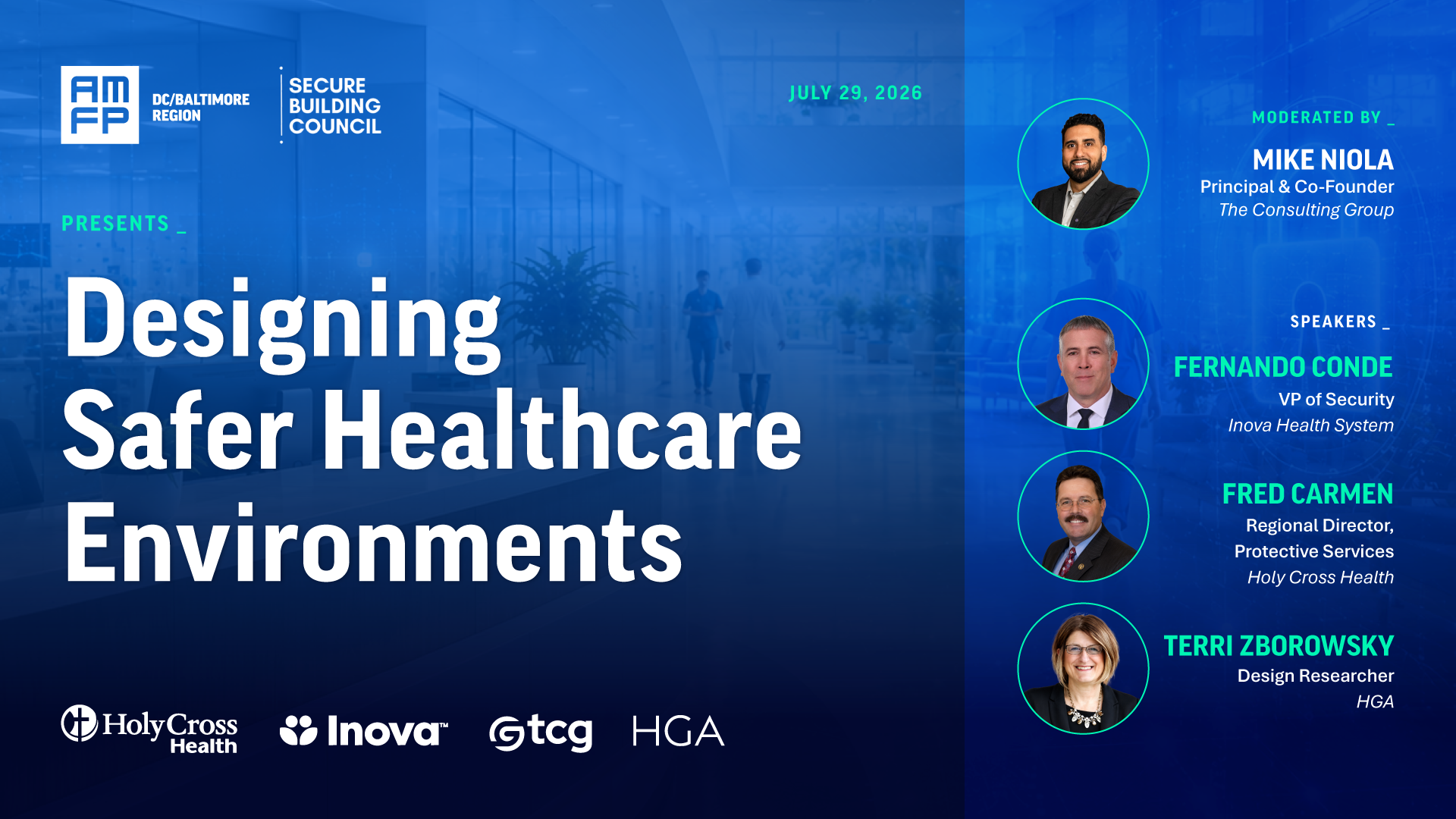
On July 29, 2026, AMFP DC/Baltimore, in collaboration with the Secure Building Council, brought together leaders in healthcare security, operations, and design for Designing Safer Healthcare Environments — a conversation focused on practical strategies for integrating security into the healthcare built environment.
The discussion featured Fernando Conde, VP of Security at Inova Health System; Fred Carmen, Regional Director of Protective Services at Holy Cross Health; and Terri Zborowsky, Design Researcher at HGA. The session was moderated by Mike Niola, Principal & Co-Founder of The Consulting Group and Chair of the AMFP DC/Baltimore Chapter.
Together, the panel brought perspectives from healthcare operations, security, clinical care, research, and design to explore a central question: how can we create healthcare environments that are safer without compromising the experience of care?
Key Highlights
- Security has to start before technology — understanding how people move through a facility, where vulnerabilities exist, and how the organization responds, before specifying cameras, access control, or duress systems.
- Healthcare environments can't operate like fortresses; CPTED principles — visibility, access control, territorial reinforcement, circulation, lighting — let architecture itself contribute to security without compromising the patient experience.
- No single security measure covers every threat. Layered protection across site, building, technology, and operations, coordinated and built to adapt, is what creates resilience.
Hosted by the Secure Building Council.
Watch the Full Webinar ↗Security Starts Before Technology
One of the central themes of the conversation was that security cannot begin with a list of devices.
Cameras, access control, intercoms, duress systems, and other technologies are important, but they are only part of a larger security program. Effective solutions begin by understanding the environment: how people enter and move through a facility, how staff work, where vulnerabilities exist, what policies are in place, and how the organization needs to respond when something happens.
That means bringing security into planning and design conversations early — alongside architecture, clinical operations, facilities, IT, and other stakeholders. When these disciplines work together from the beginning, security can become part of the environment rather than something added to it later.
Designing for Both Safety and Experience
Healthcare facilities cannot operate like fortresses. Patients and families may already be experiencing stressful or vulnerable moments, and an environment that feels overly restrictive can work against the broader mission of care.
The challenge is therefore not simply to make a building more secure. It is to create layers of protection that support safety while maintaining intuitive circulation, accessibility, dignity, and a welcoming patient experience.
This is where thoughtful planning and principles such as Crime Prevention Through Environmental Design (CPTED) become particularly valuable. Architecture itself can contribute to security through visibility, access control, territorial reinforcement, circulation, lighting, and the careful organization of public, semi-public, and restricted spaces.
Understanding How the Facility Actually Operates
A security strategy that looks good on a drawing may not necessarily work in practice.
Healthcare environments operate around complex clinical workflows, staffing models, patient populations, visiting policies, emergency procedures, and around-the-clock operations. Those realities need to inform design decisions.
The discussion reinforced the importance of involving the people who will ultimately operate the facility. Security teams, clinicians, facilities personnel, IT professionals, and other end users can identify operational requirements and potential conflicts that may not be obvious during design.
The objective is not simply to deliver systems — it is to create an environment and security program that people can realistically operate long after the project team has left.
Layered Security Creates Resilience
No individual security measure can address every threat. Instead, safer healthcare environments rely on layers of protection across the site, building, technology, and operations.
Those layers may begin at the property perimeter and continue through parking, building entrances, public areas, clinical spaces, staff areas, and highly restricted environments. Architecture, security technology, policies and procedures, staffing, communication systems, and emergency response all contribute.
When these elements are intentionally coordinated, each layer supports the others — helping organizations reduce vulnerabilities while creating more resilient environments.
Planning for Change
Healthcare security is not static. Facilities evolve. Technology changes. Clinical operations shift. New risks emerge, and organizations learn from incidents both within their own facilities and across the healthcare industry.
Security strategies therefore need to be adaptable. Rather than designing only for today's requirements, teams should consider how infrastructure, systems, and operational strategies can accommodate future technologies and changing needs. This can help healthcare organizations make smarter capital investments while avoiding solutions that become difficult or costly to modify.
A More Integrated Approach to Healthcare Security
Perhaps the strongest takeaway from the discussion was that creating safer healthcare environments requires collaboration. Security professionals cannot solve the challenge alone. Neither can architects, engineers, clinicians, IT teams, or technology consultants.
The strongest outcomes come when these perspectives are brought together early enough to influence the project. For healthcare organizations and project teams, that means moving beyond the question of "What security technology do we need?" and asking broader questions: How should this environment operate? Where are the risks? How will people experience the space? And how can architecture, technology, and operations work together to address them?
"That shift — from treating security as a collection of systems to considering it as part of the complete built environment — is fundamental to designing healthcare spaces that support both safer environments and better care."
Stronger design. Safer care. Designing Safer Healthcare Environments brought together healthcare security, operations, and design perspectives around a shared goal: creating environments that protect people while supporting the experience and delivery of care.